Published
Borrowed, Not Believed: Developmental Models of Individuation as Heuristic Engines for Machine Learning
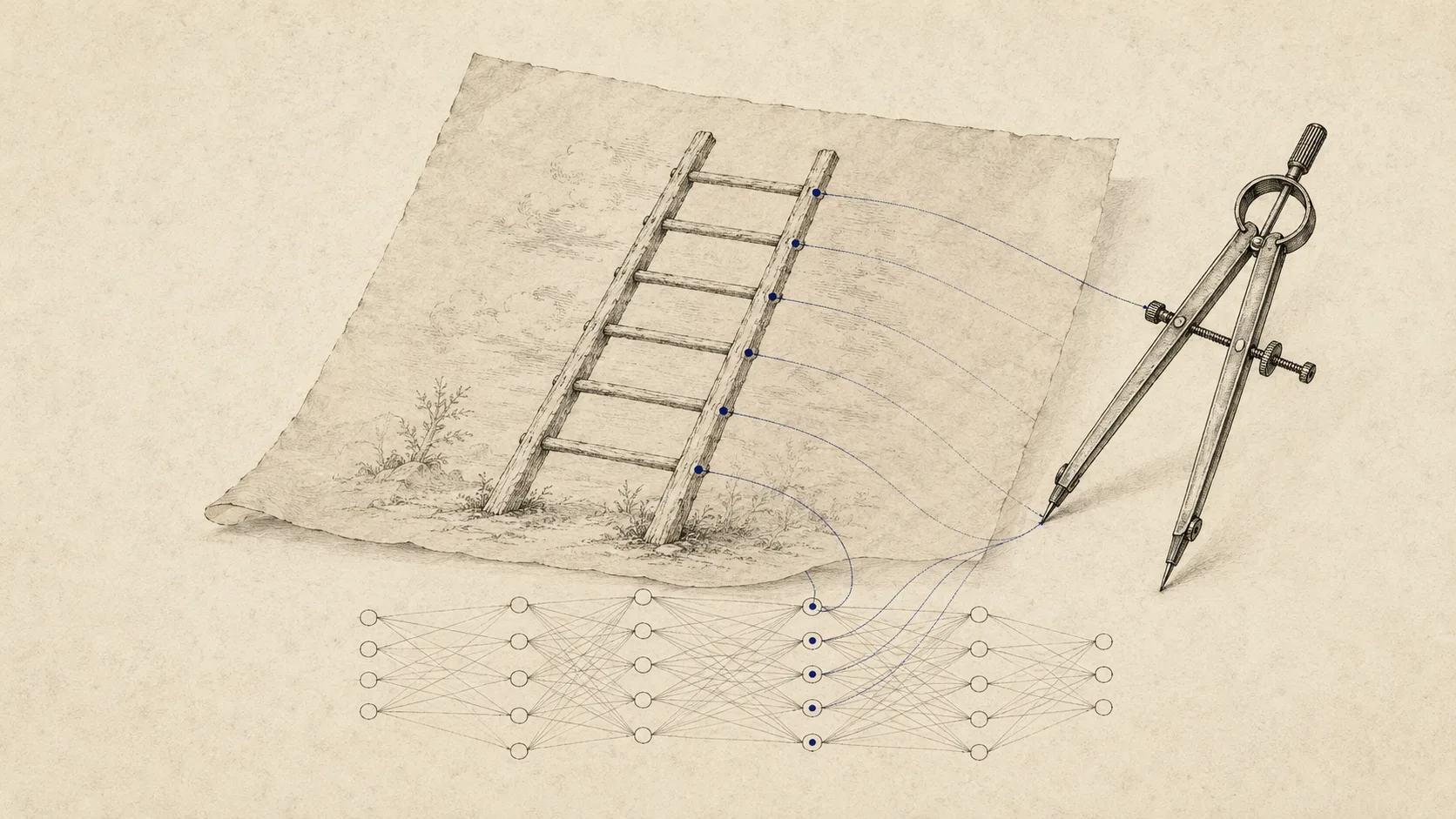
This paper treats a pre-scientific developmental schema as a disclosed source of testable machine-learning hypotheses, separating six independent interventions from a stronger dependency order that must survive matched baselines and prospective preregistration.

Abstract
Machine learning systems combine scaled models with data curation, memory, tools, feedback, persistent state, and control policies. This paper asks whether a pre-scientific developmental model can nevertheless serve as a heuristic engine: a disclosed source of candidate causal variables and dependency hypotheses, judged downstream rather than treated as evidence. From one contemplative schema we derive six proposals: faculty-ordered curriculum, controlled perspective supervision, relational continuity, lifecycle consolidation, sequential commitment stabilization, and legible-pattern worlds. They are not six homogeneous stages. Some are learner capacities, some are curriculum properties, and lifecycle consolidation is an intergenerational operation. We therefore separate a floor of independently testable interventions from a spine proposing a developmental dependency order. The correct null is not that parameter count predicts one rising axis. It is that, after compute, data, architecture, persistent state, supervision quality, and optimization are matched, the proposed variable explains no additional variance. To reduce retrospective analogy, the program also requires a provenance protocol: timestamped derivation, an explicit source-to-variable translation rule, and preregistration of each hypothesis before confirmatory literature search and testing. The paper is a research agenda, not an empirical report. The source earns standing only if prospectively derived interventions produce effects that survive strong contemporary baselines.
In simple terms
The main idea: a source can generate hypotheses without proving them
The paper asks whether a pre-scientific developmental model can be used as a disclosed source of machine-learning ideas.
No one needs to believe that the model is literally true. Its only possible value is whether it generates experiments that survive modern controls.
Six testable proposals
The source is translated into six engineering proposals: faculty-ordered curriculum, controlled perspective supervision, relational continuity, lifecycle consolidation, sequential commitment stabilization, and legible-pattern worlds.
These are not six stages of one homogeneous process. Some concern the learner, some concern the curriculum, and lifecycle consolidation operates between predecessor and successor systems.
The floor and the spine
The floor consists of six independently testable interventions. One can work even if the others fail.
The spine is a stronger dependency claim: structured state, reactive updating, registered limited state, relational anchoring, explicit self-representation, and calibrated self-regulation may need to develop in a particular order.
The spine requires local omission, reversal, and timing effects. It is not supported merely because some of the six independent interventions work.
Preventing retrospective analogy
A rich symbolic source can be made to resemble almost anything after the fact.
Future hypotheses must therefore follow a provenance protocol: record the source passage and translation before confirmatory literature search, preregister the predicted contrast and refutation condition, and then test the result against strong contemporary baselines.
What success and failure mean
If an intervention adds nothing after compute, data, architecture, state, supervision, and optimization are matched, that proposal fails.
If individual interventions work but the proposed order does not, the floor may survive while the spine fails.
Even successful experiments would not validate the source metaphysically. They would show only that it served as a productive heuristic engine.
Keywords
License
 Creative Commons Attribution-NonCommercial-NoDerivatives 4.0 International