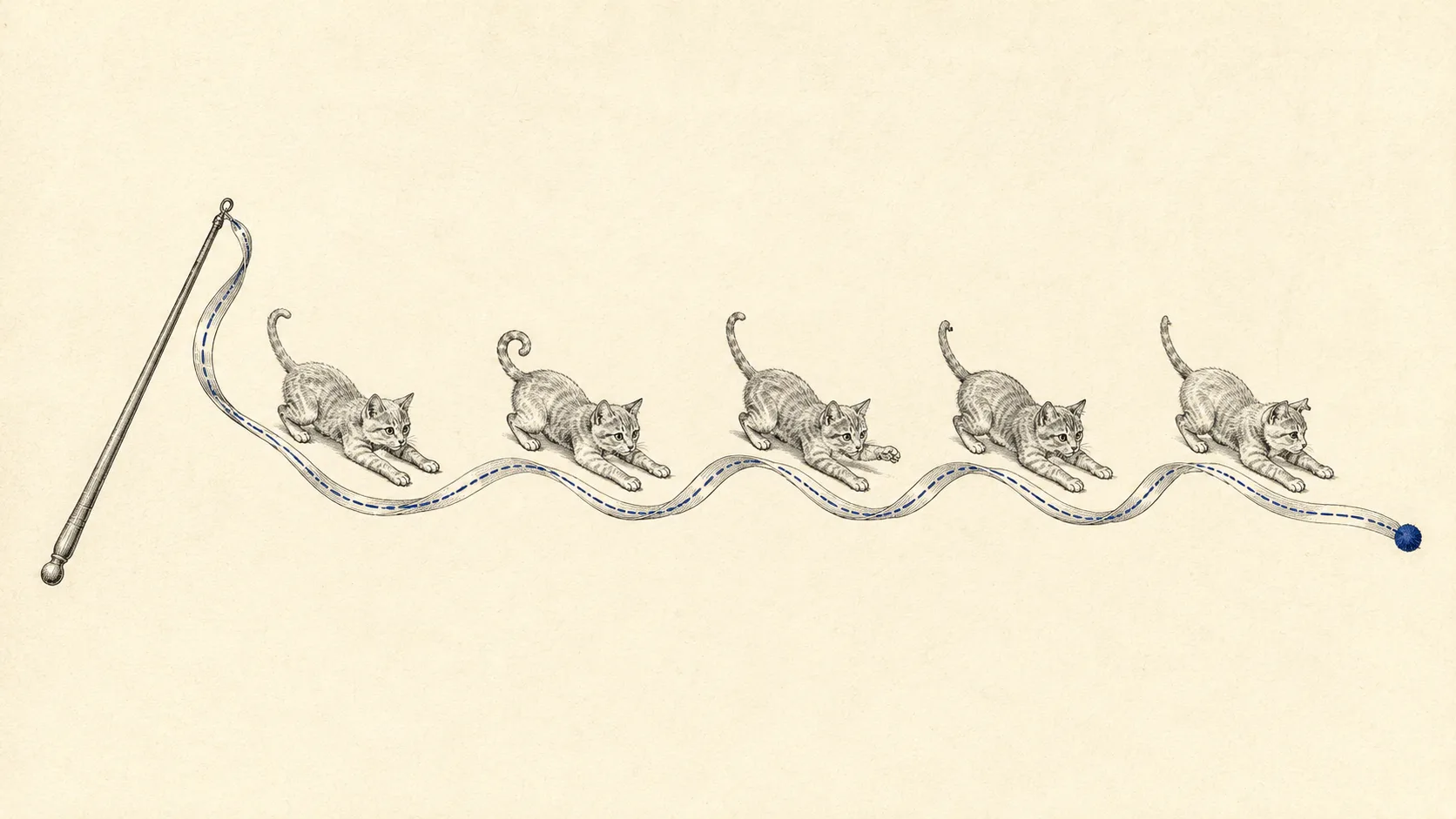
I have five cats. Five similar bodies, five almost identical repertoires of instinct, and five creatures that cannot be confused for a single minute.
I noticed it while dragging a ribbon across the floor. The pounce came from all of them: the pupil that widens, the body that drops, the hips that sway, the leap. It is the same gesture in five bodies, as old as the species, set off by a movement none of them had to learn to recognize from scratch. In that instant, the five are one cat.
A second later, they separate again. One carries the ribbon under the sofa and stands guard over it, jealous. Another loses interest at once, like someone who already knows the thing is not food. A third plays with the delicacy of someone afraid of breaking the toy. The pounce belongs to the species. What comes after the pounce belongs to each one.
What nature hands over
As a rough approximation, two layers seem to arrive ready-made.
The body is the hardware: claws, retina, neural circuits whose architecture begins to form before any conscious experience.
Instinct is the software: inherited predispositions to hunt, flee, court, care, recognize certain signals and respond to them. The analogy helps to pose the question, but it does not literally describe an organism. The body changes with experience; instinct also blends into learning; and neither one arrives entirely finished.
The classical ethology of Konrad Lorenz and Niko Tinbergen, recognized by the 1973 Nobel, described action patterns triggered by sign stimuli. Today we know that even these behaviors vary with context, with development, and with the history of the individual. Even so, something in the pounce comes before deliberation. The cat does not need to formulate the intention of hunting the ribbon for its body to be already getting ready.
Breeds show another part of the problem. Selective breeding can make certain traits more likely: a typical temperament, greater hunting intensity, a recurring way of bonding with people. But it does not fix a program. There are differences between breeds and even larger differences within each one. Inheritance hands out tendencies; it does not write a complete character.
What shows through
And still, within the same breed, each animal goes on being one.
This could be nothing more than my tenderness projecting a person where there is an animal. The objection should not be dismissed. But two facts make the question harder.
Take genetically identical mice and put them all in the same large enriched environment. In a study published in Science in 2013, forty isogenic mice living in the same enclosure developed exploratory trajectories that grew more and more different. Those trajectories correlated even with differences in the formation of new neurons in the hippocampus.
The enclosure was shared, but the experience was not. Each animal covered different places, met other individuals at different moments and, by acting in a way of its own, came to produce a world of its own. Identical genes and a common setting did not result in identical lives.
And there is CC, the first cloned cat, born in 2001 from the nuclear DNA of a cat named Rainbow. CC had a different distribution of colors in her coat, a possible outcome of developmental processes, and was described by those who lived with both as having a different temperament. The coat is a documented fact; the temperament comparison is an observation, not a controlled experiment. CC does not prove the existence of a monad. It only shows, in a particularly visible way, that cloning a genome is not reproducing an individual.
When genetics and shared setting are held as close as possible, individual variation does not disappear. Something emerges that was not specified in advance as a complete script.
The fork, and where I place my bet
Science has a sober answer for that emergence: development. No organism assembles itself the same way twice. Cellular variation, epigenetic regulation, unshared encounters, and the effects of behavior itself on the environment form feedback loops. In a sensitive system, small initial differences can amplify until they become a stable way of being in the world. There is no need to posit a separate user to explain this.
Here I stop reporting and start betting, and I want the line between the two clearly visible. Everything I have written so far stands without my metaphysics: the ethology, the mice, the clone, the divergence produced by development. What comes now is philosophical reading, not result.
I bet that this singularization is also the place where the monad begins to show through.
Nature certainly manufactures singular organisms. What I doubt is that the description of those organisms exhausts whoever inhabits them. It builds vehicles and equips them with predispositions tuned over millions of years for the life of a species. In my reading, the monad manifests through that assembly the way a musician manifests through an instrument that is also being shaped while it is played.
The monad, here, is not a finished personality sitting behind the eyes, nor a small pilot at the controls. According to the map I propose in The Journey of the Monad, it exists before the "I," but does not yet know itself as separate. Almost everything it does at this stage passes through the common repertoire, through the group soul of the species. The pounce belongs to all of them and to none.
But it does not fit entirely into the description of the repertoire. And what comes through at the edges (the jealous one, the bored one, the delicate one) need not be a personality brought ready-made from somewhere else. It may be the first outline the monad acquires as it learns to manifest through a vehicle that is increasingly capable of separation.
The cat does not say "I" the way we say it. Whether it already knows itself as someone in some faint way, I have no way of knowing. What it lets me see is the threshold: not a complete user, but the draft of the one who will one day ask the question.
That is the only thing my cats show me, and they show it well. The vehicle and the repertoire of the species do not exhaust the creature that appears in front of me.
I cannot demonstrate that this reading is correct. Anyone who looks at the same data and sees a subject entirely emergent from development is not being obtuse, they are betting differently. I only ask that nobody confuse the two halves of this text.
The ribbon is always the same for all five. That is why I drag it: not only to watch the pattern of the species wake up, but to see, a second later, what each one does with it.
And us?
The question that remains, however, is not about cats. If nature hands me something like hardware and software, it handed me mine too. What started running in me before any choice? The startle that arrives before the thought. I stay alert in the dark. The pull that a baby's cry exerts on so many adults. I insist on seeing a face in the clouds. The hunger to belong to a group, and the suspicion of whoever seems to threaten mine. Experience and culture shape all of it, but none of it began as a conscious decision. It was already in motion when I learned to call it "I."
And there is an uncomfortable part in this. I can see the cat's program because I am outside it. In my own, I am inside. I do not see the ribbon being dragged.
So the question stays, and I do not have the answer: how much of what I call myself is the monad showing through, and how much is only the pounce of the species, set off by a stimulus I do not even notice is there?
References
Action patterns, sign stimuli, and innate releasing mechanisms: concepts from the classical ethology of Konrad Lorenz and Niko Tinbergen. Nobel Prize in Physiology or Medicine, 1973 (shared with Karl von Frisch). The rigid separation between innate and learned behavior was later qualified. nobelprize.org · PMC6394777
The divergence of exploratory trajectories in genetically identical mice living in the same enriched environment: Julia Freund et al., "Emergence of Individuality in Genetically Identical Mice", Science, 2013. science.org
The first cloned cat, CC, born in 2001 at Texas A&M from the nuclear DNA of Rainbow; the scientific paper documents the cloning and the difference in the coat, not a controlled comparison of temperament: Taeyoung Shin et al., "A cat cloned by nuclear transplantation", Nature, 2002. nature.com · vetmed.tamu.edu
The joint influence of inheritance, environment, and development on the temperament of cats: PMC7552130
The monad, the vehicles, the group soul, and individualization are developed in my book The Journey of the Monad.
Keywords
individuationanimal personalityinstinctethologyconsciousnessthe monadtheosophyphilosophy of minddevelopmentgenetically identical miceanimal cloningidentity