
Project · Live · Open source

Jiddu — Critical Reading
Jiddu is where I work directly with AI: designing prompts, orchestrating agents, routing models, and testing their output against evidence. I designed and built it as a critical-reading product. It is now open source under the MIT License.
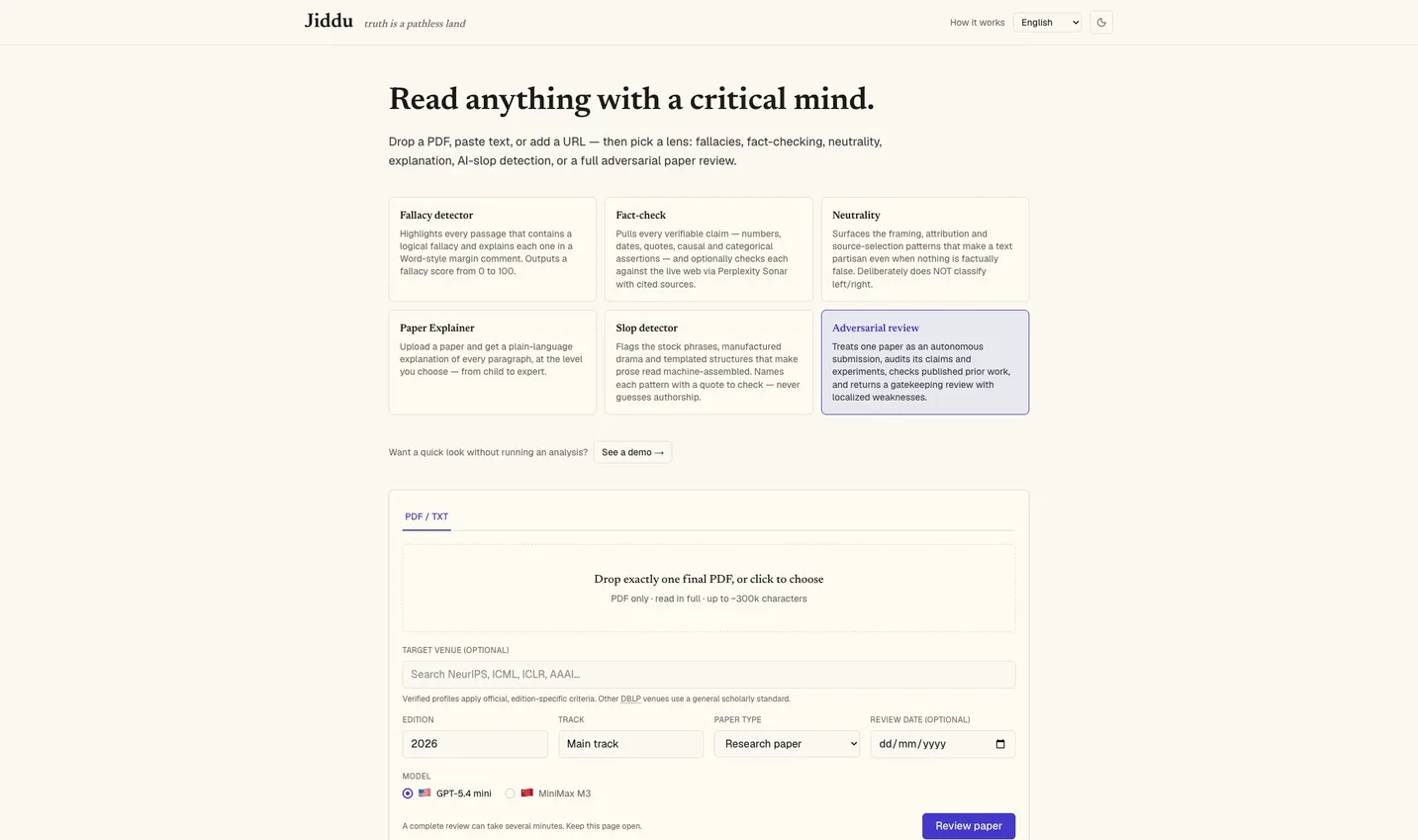
A user can paste text or an image, open a public URL, upload a PDF, TXT file, or screenshot, and choose the kind of scrutiny the material needs. Jiddu preserves the document's structure, streams findings as they become available, keeps each conclusion tied to its supporting passage or page, stores the result in the user's account, and produces an unlisted share link and print-ready view.
The name is a nod to Jiddu Krishnamurti, who declared in 1929 that truth is a pathless land. No authority or method can hand it to you; you have to get there yourself. Jiddu follows that principle. It gives readers evidence, questions, and ways of examining a text, then leaves the judgment with them.
Open source under the MIT License
I released Jiddu's original code and documentation under the MIT License. The GitHub repository includes the complete web application, analysis pipelines, prompts, agent integrations, local MCP package, and Chrome extension.
I keep using Jiddu to work through decisions that matter in an AI product: which model to use for each task, how agents share context, how to check the quality of a result, and what each analysis costs. The code and evaluation reports are available for others to study, run, and adapt.
The README covers local setup with your own provider accounts and API keys.
What this project demonstrates
Six separate workflows
Each mode has its own prompt, schema, ingestion rules, model routing, streaming contract, validation, persistence, viewer, failure path, and billing policy. A simple form starts each mode. Behind it, every analysis runs as a separate product workflow.
Evidence as part of the interface
Findings quote the source and stay anchored to a sentence, paragraph, section, figure, or manuscript page. Readers can move from a synthesis back to its supporting passage and inspect the model answer in context.
Different models for different jobs
Jiddu uses GPT-5.6 Luna as its primary analysis model and Gemma 4 31B as an alternative for comparison. GPT-5.6 Luna Pro handles deep paper analysis, Claude Opus 4.8 provides criticism and adversarial review, and Perplexity Sonar handles fact-checking, news, and contextual research. GPT Live Transcribe and GPT-4o Transcribe Diarize cover real-time transcription and speaker identification. Fallbacks are bounded and recorded, and incomplete results are never replaced silently.
Long-running AI work
Adversarial reviews run as persistent background jobs. A user can close Jiddu while the review continues, return through the account area, and inspect the current stage, elapsed time, model calls, fallbacks, failures, and final result.
One account across several clients
WorkOS AuthKit provides browser sessions, account security, REST API identity, and OAuth for the hosted MCP server. The same account, analysis history, access rules, and credit balance follow a user across the web app, API, MCP clients, Jiddu Live, and the Chrome extension.
Billing tied to actual usage
Jiddu Credits reserve an estimate before work starts, then settle from the actual token and provider cost of completed model calls. Live transcription is billed from audio duration, while Live analysis is billed by completed analysis window and selected lens. Users can buy one-time credit packs through Stripe and inspect every debit, reservation, release, and purchase in their account.
Six critical-reading systems
Fallacy detector
Jiddu highlights passages containing logical or rhetorical fallacies, explains each one in a margin comment, assigns severity, and produces a document score from 0 to 100. The catalog contains 46 fallacies covering relevance, ambiguity, presumption, emotional appeals, causal reasoning, and evidence. Long documents are split at sentence boundaries and analyzed in parallel without losing the link to the original passage.
Fact-check
A Claimify-inspired pipeline selects verifiable sentences, resolves ambiguity, decomposes compound assertions, and rewrites each claim so it can stand on its own. Users can then verify claims individually or in bulk through live web search. Each verdict is supported, contradicted, mixed, or unverified, with confidence, rationale, citations, and a six-tier classification of source quality. Equivalent recent claims can reuse cached verdicts, while users can request a fresh verification when needed.
Neutrality assessment
Jiddu detects framing and source-selection patterns that can make a text partisan even when its factual claims are correct. It covers loaded language, asymmetric attribution, false equivalence, selective omission, source asymmetry, both-sidesing, steering, and genetic framing. It deliberately avoids left/right or pro/anti labels and instead surfaces specific passages the reader can audit.
AI-slop detector
This workflow flags observable writing patterns and makes no claim about authorship. Its 18-pattern catalog covers stock wording, manufactured drama, templated structure, hollow substance, and format tics. Every finding quotes the exact span, names the pattern, and explains what clearer writing would do without rewriting the source.
Paper Explainer
The original paragraph-by-paragraph explainer has become a guided paper-reading environment with three modes. Quick Scan assesses the paper's category, context, apparent correctness, contributions, and clarity.
Understand builds a Paper Map, reconstructs the evidence chain, explains semantic sections, defines key terms, records questions for the authors, identifies confusing passages and implicit assumptions, and suggests further reading.
Challenge reads methods and results independently before comparing them with the authors' interpretation, checks whether the abstract represents the evidence faithfully, inspects selected figures and tables, and records what remains uncertain. Every synthesized statement links back to supporting paragraphs, and explanations can be written for a child, high-school student, undergraduate, or domain expert.
Adversarial paper review
Jiddu treats one final PDF as a conference submission. Five independent SPECS passes examine Story, Presentation, Evaluations, Correctness, and Significance before synthesis. The pipeline builds a claim-and-evidence ledger, researches relevant literature, performs safe deterministic arithmetic checks, validates cited sources, asks an independent critic to challenge the draft, and applies a retention gate so major specialist findings cannot disappear from the final review.
Verified venue profiles apply official criteria for NeurIPS, ICML, ICLR, AAAI, IJCAI, and CVPR; other DBLP venues use a clearly labeled general scholarly standard. Reviews export to structured Markdown and PDF.
Jiddu Live
Jiddu Live brings the same reading system to spoken material. It can transcribe a microphone or, in Chromium browsers, the audio from another browser tab.
Before starting, the user selects one or more lenses: fallacies, check-worthy claims, and neutrality. Jiddu analyzes the growing transcript every 10, 20, 30, or 60 seconds and streams results into a combined feed and dedicated panels. After the session ends, detected claims can be verified against web sources and every selected lens receives its own shareable result.
Audio travels directly from the browser to OpenAI's Realtime API and is not stored. Jiddu keeps only the transcript and selected analysis results. Sessions are capped at 60 minutes and billed from actual transcription duration and completed analysis windows.
Jiddu Context
Jiddu Context turns live speech into a workspace that can be inspected while the conversation is still unfolding. An orchestrated group of specialized agents works from the same transcript to identify speakers, map people, organizations, institutions, events, and their relationships, extract check-worthy claims, search for sources, and flag neutrality or fallacy signals. Every result stays linked to the passage that produced it, while a dockable interface keeps the transcript, graph, facts, tags, and rhetorical analysis visible at the same time. Users can rearrange the panels, correct speaker names, save the resulting workspace, and return to it later as a navigable record of the session.
Screenshots and layout-aware reading
The five text workflows accept PNG, JPEG, and WebP screenshots up to 10 MB. Images can be pasted from the clipboard, dropped onto the page, or selected as files. A vision model extracts the visible text before the chosen analysis begins, and Jiddu does not retain the original image.
PDF ingestion uses LiteParse to preserve headings, semantic sections, reading order, page boundaries, and layout signals. The Paper Explainer and adversarial review can also inspect selected rendered pages when figures, tables, or visual structure carry evidence.
The standard analysis viewers now preserve document sections and paragraph boundaries. References are separated from the main argument so citations do not become accidental findings.
Jiddu for Chrome
Jiddu for Chrome brings three reading lenses directly into any webpage. After activating the extension, the user selects a passage and chooses Fallacies, Facts, or Bias. The result opens in Chrome's side panel without replacing the page being read.
Each tab keeps its own report. The extension can print a clean result, supports English, Portuguese, and Spanish, and connects to the user's Jiddu account through a revocable personal API key. It uses temporary tab-scoped storage for the page title and URL; only the deliberately submitted passage is sent to Jiddu.
The extension is published on the Chrome Web Store and available through its direct listing.
Web, REST, and MCP
The browser is one client of the same analysis system. Five synchronous REST endpoints expose fallacy detection, fact-checking, neutrality assessment, slop detection, and explanation. Adversarial review uses an asynchronous job API because a full review may take several minutes.
Verified users can create and revoke their own API keys from the account area. Keys are shown once, stored only as hashes, rate-limited independently, and bound to the account that created them. Successful and failed API runs appear in the same analysis history as work created through the web interface.
A hosted MCP server exposes the same text tools plus commands to start and monitor adversarial reviews. Compatible agents authenticate through WorkOS OAuth, so they do not need a manually copied REST key. A standalone MCP package is also available for local use.
Accounts, billing, and operations
The account area now combines profile and security controls, analysis history, background review jobs, credit balance and transaction history, API-key management, and authenticated support.
One-time Jiddu Credit packs are sold through Stripe Checkout. Signed webhooks and the authenticated return flow use the same idempotent fulfillment path, while the credit ledger remains the source of truth for purchases and usage.
The production database has moved from SQLite to PostgreSQL 16. Operational tools cover model usage, analysis history, feedback reports, verdict cache state, route limits, model routing, cost caps, account access, credit administration, and human-review flags. Public contact and signed-in support requests run through Resend.
Methodology and evaluation
Jiddu uses published work as a starting point, then implements its own prompts, schemas, orchestration, safeguards, and interface:
- Claimify informs the four-stage claim-extraction process.
- Distilling Expert Judgment at Scale informs fact-check assessment, source tiers, and the neutrality framework.
- AI-Assisted Peer Review at Scale informs the SPECS dimensions and staged review pattern.
- Peter Yang's no-ai-slop supplies the starting taxonomy for writing-pattern detection.
67.5%
Human-verdict match across 200 PolitiFact claims. Agreement rose to 81.3% on the unambiguous true, false, and pants-on-fire cases; strict polar disagreement was 4.5%.
30 / 30
Injected defects detected by GPT-5.4 mini, GPT-5.5, GPT-5.6 Luna, and GPT-5.6 Luna Pro in a synthetic SPECS benchmark. The set reached a ceiling, so it validates prompt regression coverage but does not establish accuracy on complete real-world papers.
Status
Jiddu is live at jiddu.app, with complete interfaces in English, Portuguese, and Spanish. Public demos cover all six workflows without consuming credits. The web app, REST API, hosted MCP server, Jiddu Live, Stripe billing, account tools, background paper reviews, and Chrome extension are in production.
Built with
AI models
GPT-5.6 Luna
Primary analysis model
Gemma 4 31B
Alternative for comparison
GPT-5.6 Luna Pro
Deep paper analysis
Claude Opus 4.8
Criticism and adversarial review
Perplexity Sonar
Fact-checking, news, and contextual research
GPT Live Transcribe
Real-time transcription
GPT-4o Transcribe Diarize
Speaker identification
Further reading

